Build a Differentiated Yoga Brand: Complete Guide to Custom Apparel
July 12, 2026Dayu
Meta Title: How to Build a Differentiated Yoga Brand
Meta Description: Learn how to build a yoga brand that stands out through clear positioning, distinctive products, custom yoga apparel, effective OEM/ODM partnerships, and a focused launch strategy.
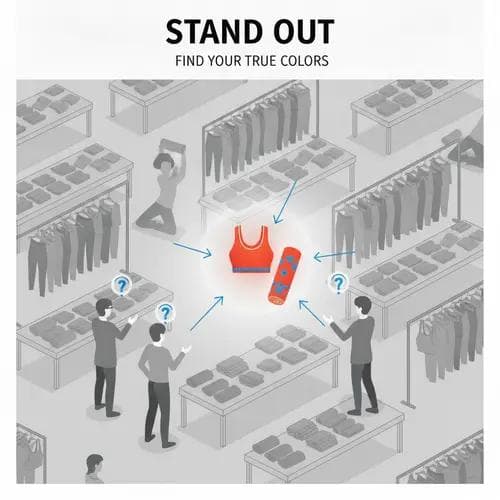
The yoga market is crowded with activewear labels, studio merchandise, wellness businesses, lifestyle communities, and digital-first startups. New brands are not only competing with established yoga clothing companies; they are also competing for attention against athleisure brands, fitness retailers, creators, marketplaces, and increasingly selective customers.
That does not mean there is no room for another yoga brand. It means that a generic brand is unlikely to earn lasting attention.
A differentiated yoga brand gives customers a clear reason to remember it, trust it, and choose it. That difference may come from a precisely defined audience, a recognizable design language, a superior fit system, a specialized product function, a compelling community, or a combination of these elements. The strongest brands connect their positioning to the product itself, so the promise is visible and tangible in every garment.
This guide explains how to build a yoga brand that can compete in a saturated market, from defining your niche and developing custom yoga apparel to selecting an OEM/ODM partner, planning a coherent collection, and launching with greater commercial discipline.
When products look similar, customers tend to compare familiar factors such as price, convenience, social proof, and delivery speed. That is a difficult environment for a new brand because larger competitors usually have more traffic, more reviews, and larger marketing budgets.
Differentiation changes the basis of comparison. Instead of asking, “Why should I buy another pair of leggings?” the customer begins to ask, “Is this the product designed for someone like me?”
A meaningful point of difference should influence more than a slogan. It should guide product selection, materials, fit, color, packaging, content, pricing, customer experience, and manufacturing decisions. A brand positioned around studio-to-street versatility, for example, should not simply repeat that phrase in advertisements. Its garments should provide the comfort required for movement, the coverage expected in class, and the visual refinement needed for everyday wear.
Effective differentiation is a connected system: the target customer, brand promise, product experience, and market presentation must reinforce one another.
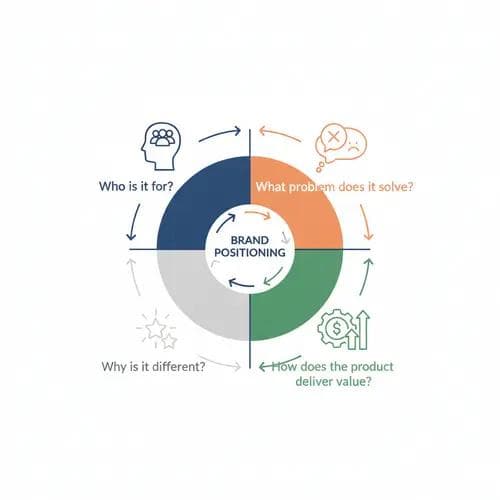
Many emerging brands describe themselves with broad phrases such as “premium activewear for modern women” or “comfortable, sustainable yoga clothing.” These ideas may be positive, but they are too general to define a defensible position.
A useful position answers four questions:
For example, a brand could serve yoga teachers who need polished, high-durability apparel for teaching multiple classes each day. Another could develop modest yoga clothing with carefully engineered coverage. A third might focus on petite customers who struggle with standard inseams and misplaced compression zones. Each direction creates clearer product-development requirements than a generic promise of comfort.
A practical positioning statement can follow this structure:
For a defined customer, our brand provides a specific product category or experience that delivers a meaningful benefit, supported by a credible product or service advantage.
Your positioning statement is an internal decision-making tool rather than necessarily a public tagline. It should help your team decide which products to develop, which features deserve investment, which content to create, and which opportunities to reject.
| Positioning Element | Weak Approach | Stronger Approach ||---|---|---|| Audience | Everyone who likes yoga | Yoga teachers managing long studio days || Benefit | Comfort and style | All-day support without a restrictive feel || Product proof | High-quality fabric | Tested fit, stable waist construction, and abrasion-resistant fabric || Identity | A healthy lifestyle | A confident professional identity for movement educators || Market signal | Trend-led visuals | A consistent design system aligned with the audience |
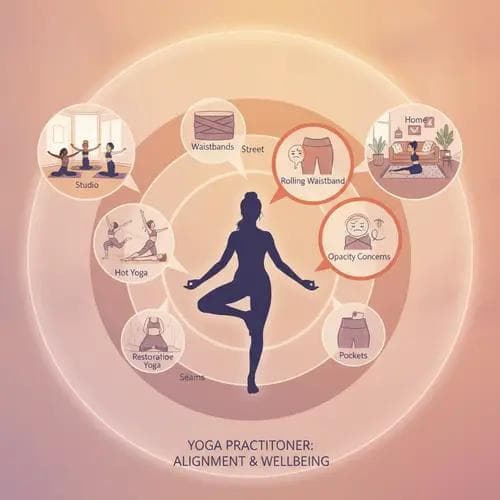
Age, location, and income can help with media planning, but they rarely explain why a person chooses one yoga brand over another. Product development requires a deeper view of the customer’s routines, frustrations, preferences, and buying criteria.
A useful customer profile should consider:
A hot-yoga customer may prioritize quick drying, secure coverage, minimal bulk, and sweat management. A restorative-yoga customer may care more about softness, unrestricted movement, gentle waist construction, and layering. A studio owner ordering branded apparel may need dependable sizing, repeatable quality, customization support, and manageable order quantities.
These differences should shape the specification of the product. Customer research is therefore not only a marketing task; it is an input into apparel design, fabric selection, sample evaluation, and quality control.
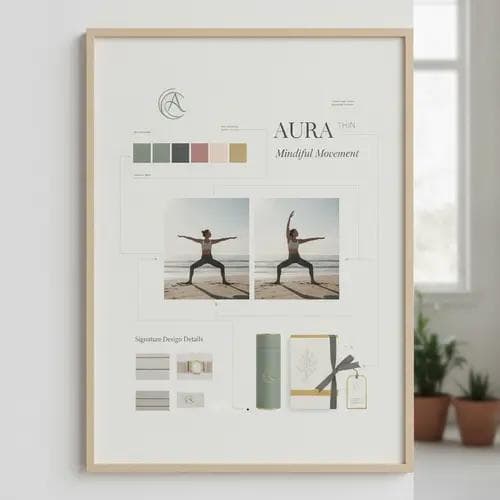
A yoga brand identity includes the name, logo, typography, color system, photography, packaging, tone of voice, and the visual details applied to products. Recognition grows through consistency, not through adding more design elements.
Begin by defining three to five brand characteristics. A brand may be technical, disciplined, and understated; expressive, energetic, and inclusive; or calm, tactile, and refined. These characteristics should guide both communication and product design.
For apparel, a distinctive identity can be expressed through:
Avoid treating a logo as the entire brand. A large logo can make a product noticeable, but it does not automatically make the brand distinctive. Product proportion, fit, tactile quality, and construction details often create stronger long-term recognition.
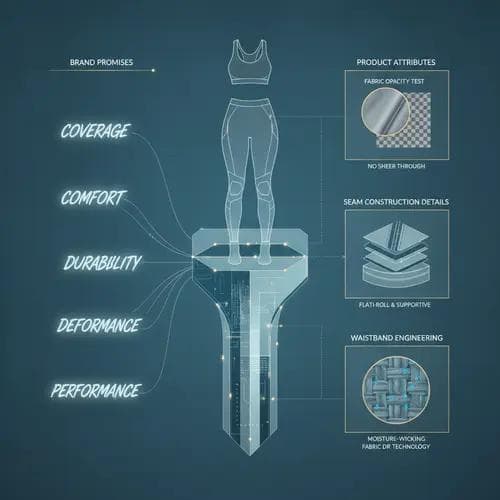
Marketing can attract an initial purchase, but the product determines whether the promise feels credible. In yoga apparel, customers experience the brand through stretch, recovery, hand feel, opacity, support, seam comfort, fit consistency, wash performance, and overall durability.
A strong product strategy translates positioning into measurable development priorities. If the brand promises reliable coverage, the team should define expectations for fabric opacity, color behavior, garment construction, and fit across movement. If the brand focuses on all-day comfort, the team should examine compression, seam placement, waist pressure, breathability, and prolonged wear.
More features do not necessarily create a better product. They can add cost, weight, construction complexity, and visual clutter. Select features because they solve a relevant customer problem or reinforce the brand identity.
| Brand Direction | Product Priorities | Possible Customization Focus ||---|---|---|| Performance yoga | Stable fit, moisture management, support, recovery | Technical fabrics, bonded details, ventilated panels || Everyday wellness | Soft touch, easy layering, comfort, versatility | Brushed fabrics, refined colors, minimal seams || Inclusive fit | Size consistency, coverage, adaptable support | Extended grading, adjustable elements, fit testing || Studio merchandise | Brand visibility, reliable replenishment, broad appeal | Logo application, versatile colors, accessible silhouettes || Premium fashion yoga | Distinctive form, elevated finish, limited collections | Custom patterns, signature trims, specialized dyeing or prints |
The aim is not to copy every feature currently popular in the market. It is to develop a focused product experience that customers can associate with your brand.
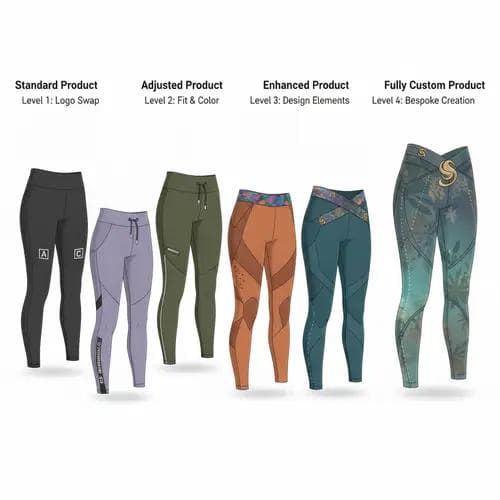
Private-label catalog products can help a brand enter the market efficiently, especially when speed and lower development complexity are priorities. However, extensive dependence on standard products can make differentiation harder if competitors can source similar silhouettes.
Custom yoga apparel development allows the product to reflect a more specific market position. Depending on the manufacturing model and project scope, customization may include:
The commercial value of customization comes from relevance, not novelty alone. An unusual seam has limited value if it irritates the wearer. A proprietary fabric has limited value if it creates unstable quality or pushes the retail price beyond what the audience will accept. Every custom decision should support customer experience, brand recognition, or operational advantage.
A fully custom product may require more development time, sampling, testing, and capital than an existing style with brand customization. Emerging businesses should choose the level of customization strategically.
A practical first collection may use proven base constructions while introducing distinctive colors, a refined fit, branded trims, and one or two signature details. As sales data and customer feedback become available, the brand can invest in more original patterns, materials, and proprietary product systems.
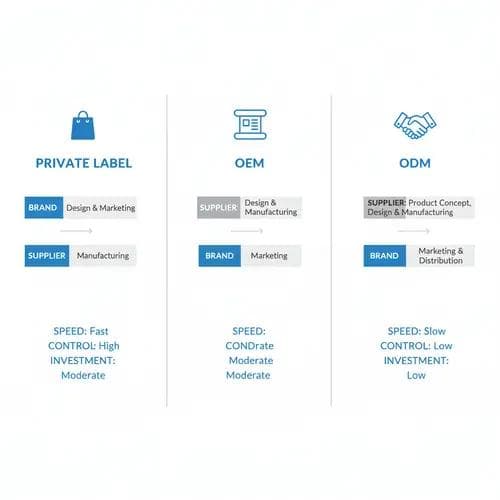
The terms private label, OEM, and ODM are sometimes used differently across suppliers. The most important step is to confirm the actual scope of service, ownership, development responsibility, and production process before beginning.
| Model | Typical Starting Point | Brand Input | Best Suited To ||---|---|---|---|| Private label | Existing supplier styles | Color, logo, labels, packaging, and selected details | Faster launches and market testing || OEM | Buyer’s design, tech pack, or detailed concept | Product specifications, branding, fit targets, and approvals | Brands with a defined product vision || ODM | Supplier-supported design and development | Market direction, audience, brand identity, and product requirements | Brands needing broader development support |
With private-label yoga wear, the brand generally selects from existing or adaptable products and applies its own identity. This can reduce development complexity and support a faster route to market.
With yoga apparel OEM, the manufacturer produces according to the brand’s design and specifications. This model can offer greater control, but it requires clear technical communication, disciplined approvals, and realistic development planning.
With yoga apparel ODM, the supplier contributes more actively to design and product development. This can be useful for businesses that understand their customer and brand direction but need support translating those ideas into manufacturable products.
Before selecting a model, clarify pattern ownership, mold or artwork ownership where relevant, exclusivity terms, sample charges, minimum order quantities, revision limits, lead times, testing responsibilities, and the handling of approved specifications.
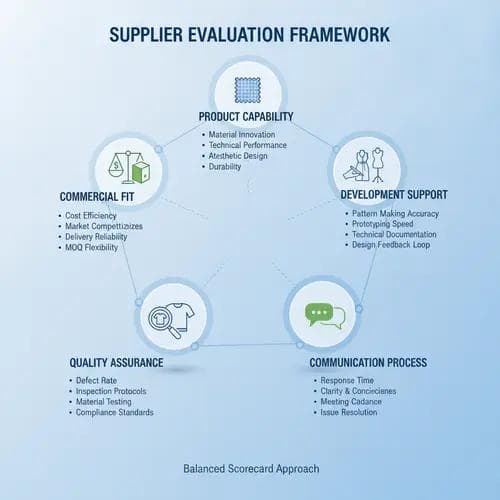
A manufacturer affects product quality, development speed, communication, inventory risk, and the customer’s experience of the brand. The lowest quotation is not necessarily the lowest total cost. Delays, unstable measurements, inconsistent colors, unclear approvals, and avoidable defects can consume margin and damage trust.
Evaluate potential yoga clothing manufacturers across several dimensions.
Review whether the supplier has relevant experience with stretch apparel, activewear construction, performance fabrics, bra engineering, and the specific product categories in your collection. A capable partner should understand how fabric behavior, stretch direction, seam choice, and pattern engineering interact.
Determine whether the supplier can assist with material sourcing, pattern development, tech packs, size grading, prototypes, logo techniques, packaging, and production planning. The required level of support will depend on your internal team.
Look for clear points of contact, documented quotations, accurate sample records, approval checkpoints, and realistic timelines. A structured process reduces ambiguity when multiple colors, sizes, materials, and styles are being developed simultaneously.
Ask how measurements, workmanship, color, fabric, trims, labels, packaging, and final goods are checked. Confirm which standards will be agreed upon before bulk production and how issues are handled if output does not match approved samples or specifications.
Minimum order quantity, sample cost, unit price, payment terms, capacity, lead time, and reorder flexibility should align with your stage of growth. A supplier may be highly capable yet unsuitable if its operating model does not match your volumes or development needs.
A productive supplier relationship is built on aligned expectations, complete specifications, documented approvals, and timely decisions from both sides.
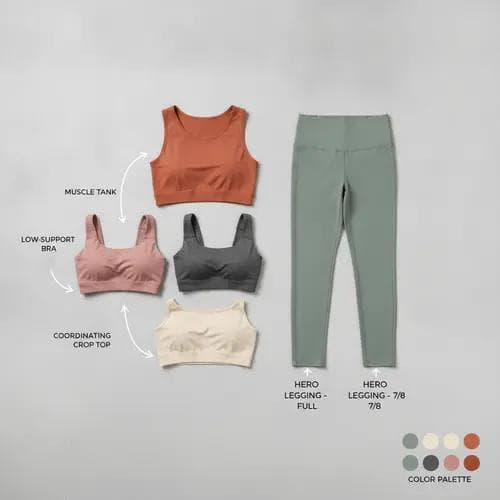
Many new brands launch too many styles because a larger range appears more established. In practice, a broad first collection can divide inventory, complicate sampling, weaken the visual identity, and make customer acquisition more difficult.
A focused capsule collection is often more effective. It can center on one clear use case and a small number of coordinated products, such as:
Each product should have a defined role. The hero item attracts attention; supporting items increase styling options and order value; repeatable core colors improve continuity; limited seasonal colors create freshness without replacing the entire assortment.
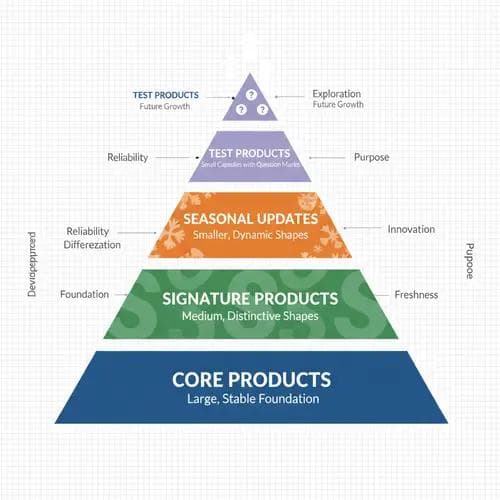
Plan the collection as a system rather than a set of unrelated garments.
| Collection Layer | Purpose | Development Approach ||---|---|---|| Core products | Build recognition and repeat sales | Stable fits and repeatable colors || Signature products | Express the brand’s difference | Custom construction or distinctive details || Seasonal updates | Create novelty and content opportunities | New colors, prints, or selected silhouettes || Test products | Validate emerging demand | Controlled quantities and clear success criteria |
This architecture can also improve manufacturing efficiency by sharing fabrics, trims, colors, and construction methods across styles where appropriate.
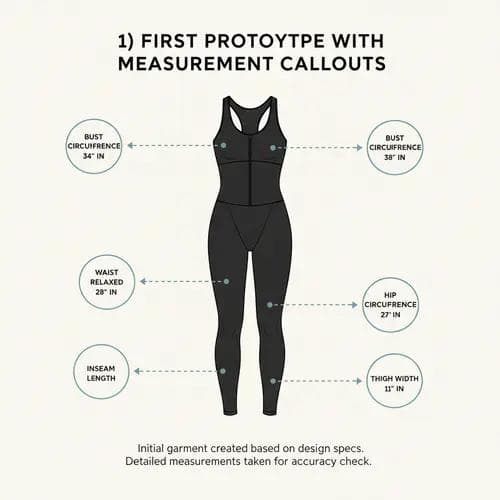
Fit is one of the most important and difficult aspects of building a yoga clothing brand. Customers may forgive a color that appears slightly different on a screen, but poor fit can lead to discomfort, returns, negative reviews, and lost confidence.
Fit development should reflect the intended customer rather than relying only on a generic sample size. Establish the target body profile, garment measurements, stretch expectations, compression level, and intended wearing experience. Evaluate the product both statically and during relevant movements.
A structured fit process may include:
Extended size ranges require intentional pattern development and grading. Simply enlarging or reducing every point by the same proportion may not preserve support, coverage, or visual balance. If inclusivity is part of the brand promise, the product-development plan and budget should reflect the testing needed to support it credibly.
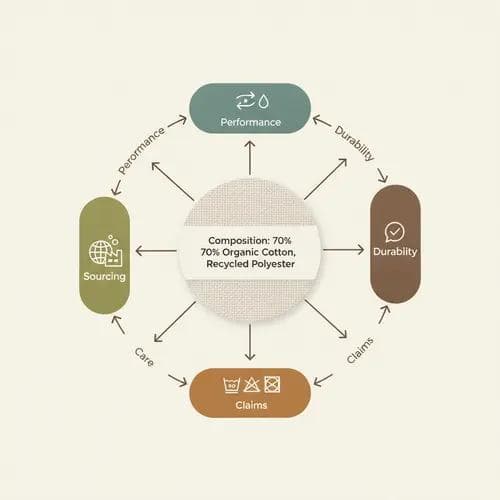
Customers increasingly pay attention to materials, durability, packaging, production practices, and the truthfulness of brand claims. A responsible strategy should begin with verifiable decisions rather than broad language.
For each fabric or trim, understand its performance, limitations, care requirements, sourcing information, and relevance to the product. A material should be chosen because it supports the intended use and brand priorities—not simply because it provides an attractive marketing term.
Durability can also be part of a more responsible product philosophy. Garments that retain fit, appearance, and function over repeated wear may provide stronger customer value than products designed mainly around rapid trend turnover.
When communicating sustainability or material attributes:
A manufacturing partner that provides clear material information and consistent traceability can make responsible communication easier, but the brand remains accountable for the claims it publishes.
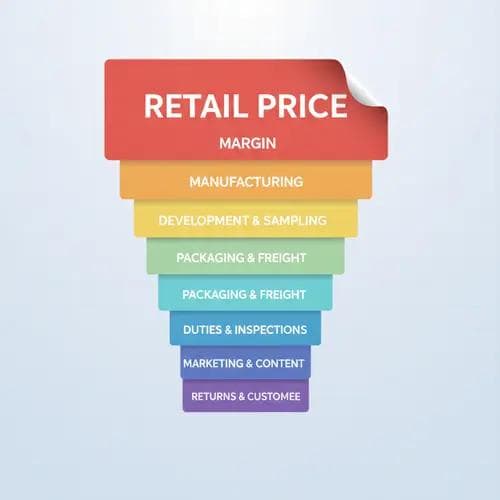
Pricing should reflect the customer’s perceived value, competitive context, channel economics, and the full cost of bringing the product to market. Unit manufacturing cost is only one part of the calculation.
A complete cost view may include development, samples, bulk production, packaging, inspections, freight, duties, warehousing, payment fees, content production, marketing, discounts, returns, and customer service. Wholesale distribution introduces another margin structure that should be considered before the retail price is finalized.
Do not position a product as premium solely by increasing the price. Premium pricing should be supported by fit, materials, finish, service, design consistency, presentation, and brand trust. Conversely, underpricing a thoughtfully developed product can limit the budget available for quality control, customer acquisition, and future development.
Create several financial scenarios before placing the first bulk order. Model the effect of different order quantities, sell-through rates, return rates, promotional discounts, and freight costs. This helps prevent a visually successful launch from becoming a commercially weak one.
A customer encounters the brand through many small details: product descriptions, size guidance, images, packaging, delivery communication, garment labels, support responses, and the item itself. Each interaction either strengthens or weakens trust.
For yoga apparel, clear communication is especially important around fit, compression, support, opacity, fabric feel, care, and intended activity. Descriptions should help customers choose, not merely persuade them to buy.
Consistency also applies to replenishment. If a core legging changes noticeably between production runs, loyal customers may lose confidence even if the new version is technically acceptable. Maintain approved samples, specifications, color standards, measurement tolerances, and production records so repeat orders can be compared with the intended standard.
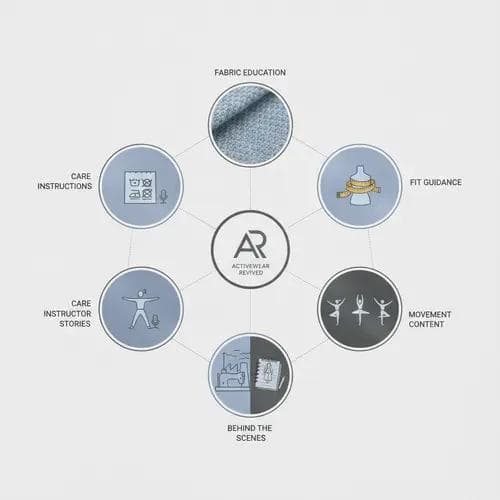
A differentiated brand does not need to discuss its products in every piece of content, but its content should reinforce the world the brand is building. Educational articles, instructor stories, movement guidance, behind-the-scenes development, fit explanations, and care information can all strengthen credibility.
Build content around customer decisions and concerns. Useful themes may include:
Search-friendly content works best when it answers a real question comprehensively. Avoid forcing keywords into every paragraph. Use clear headings, natural language, descriptive product terminology, and internal topic consistency so both readers and search systems can understand the subject.
Yoga brands often speak about community, but genuine community requires participation and exchange. It cannot be created solely through a social media campaign.
The right community strategy depends on the brand position. A brand serving instructors might create an educator feedback group, product wear-test program, or studio partnership model. A brand focused on beginners could provide welcoming guidance and collaborate with accessible local classes. A specialized product brand could invite customers to contribute structured fit and performance feedback.
Small communities can generate valuable insight before they generate significant revenue. Listen to repeated questions, observe how products are worn, and identify language customers use to describe benefits and frustrations. This information can improve product pages, future designs, and customer service.
For B2B buyers, community may also involve studio merchandise programs, co-branded collections, instructor uniforms, event capsules, or wellness-company apparel. These partnerships work best when the product, branding method, quantities, and delivery expectations are clearly planned.
A new brand does not need perfect certainty, but it does need a disciplined learning process. Testing can reduce the risk of committing too much inventory to an unproven design, color, price, or message.
Before a large launch, test key assumptions through customer interviews, material swatches, fit sessions, prototypes, wear tests, sample photography, landing-page messaging, limited drops, studio trials, or controlled preorders where operationally appropriate.
Define what you want to learn from each test. “People liked the sample” is not sufficiently specific. Better questions include:
Share relevant feedback with your development and manufacturing partners. Clear evidence helps the team prioritize revisions rather than making changes based on isolated opinions.
Competitor research is useful for understanding category expectations, but imitation produces a weaker reason to buy. Study what customers value and where current products disappoint them, then create an answer aligned with your own brand position.
A large range increases development cost, inventory complexity, and marketing demands. Begin with enough choice to communicate a complete idea, but keep the assortment focused enough to learn from actual sales.
A fabric can feel excellent as a swatch yet behave differently after cutting, sewing, printing, dyeing, washing, or repeated movement. Evaluate the complete garment under intended use conditions.
Words such as “premium,” “soft,” or “high compression” are open to interpretation. Use reference samples, measurements, material specifications, construction details, artwork files, color standards, and written approval records.
A design may become commercially unworkable after adding specialized fabric, complex seams, multiple trims, packaging, and low production quantities. Request cost feedback during development rather than after the final sample.
Claims about performance, body benefits, materials, or sustainability should be specific, accurate, and supportable. Trust is harder to rebuild than attention is to acquire.
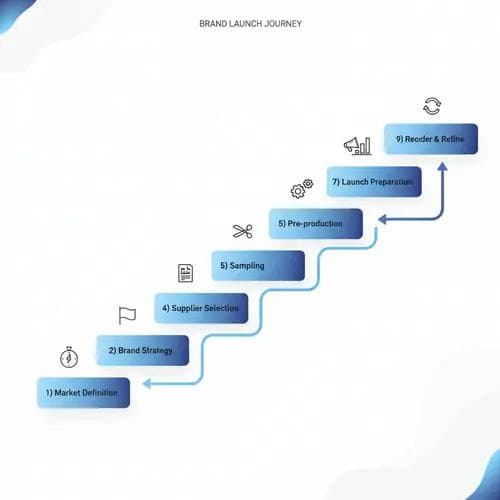
Building a differentiated yoga brand becomes more manageable when decisions are made in the right sequence.
| Stage | Primary Goal | Key Outputs ||---|---|---|| 1. Market definition | Identify the commercial opportunity | Audience, problem, competitors, positioning || 2. Brand strategy | Establish a consistent identity | Brand promise, voice, visual direction || 3. Product brief | Translate strategy into requirements | Assortment, price targets, features, materials || 4. Supplier selection | Confirm production capability and fit | Quotations, development scope, timeline, terms || 5. Sampling | Validate design, construction, and fit | Prototypes, revisions, approved samples || 6. Pre-production | Prepare controlled bulk manufacturing | Final specifications, colors, packaging, approvals || 7. Launch preparation | Build customer understanding and demand | Content, product pages, size guidance, campaign assets || 8. Market test | Measure response and identify issues | Sales data, feedback, returns, product insights || 9. Reorder and refine | Scale the strongest evidence | Improved products, focused inventory, repeatable process |
At every stage, return to the same question: Does this decision make the brand more relevant and recognizable to its intended customer? If the answer is unclear, the decision may be adding complexity without strengthening the position.
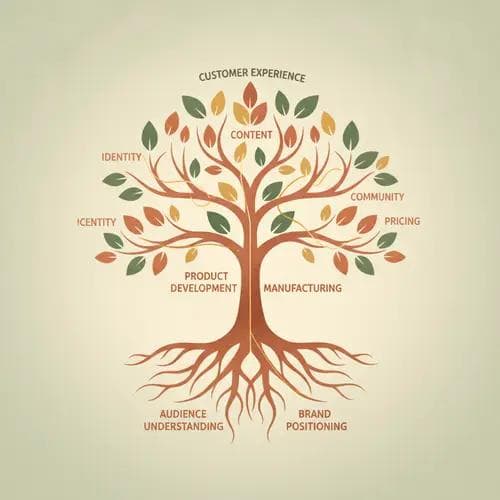
The yoga market may be saturated with products, but it is not saturated with brands that understand a specific customer exceptionally well and serve that customer with disciplined consistency.
Successful differentiation rarely comes from one dramatic idea. It comes from alignment between audience, positioning, identity, product design, fit, materials, manufacturing, pricing, communication, and customer experience. When those elements support the same promise, even a focused first collection can feel more compelling than a much larger generic range.
Custom yoga apparel can play an important role in that alignment. The right product-development approach enables a brand to move beyond a logo on a standard garment and express its position through fit, fabric, construction, color, details, and collection architecture. The right OEM/ODM partner then helps turn that strategy into a reliable, manufacturable product.
If you are developing a new yoga label, expanding an activewear collection, creating studio merchandise, or refining an existing product line, we can support your project with custom yoga apparel, private-label production, OEM/ODM development, and brand collaboration services. From material selection and product development to sampling, logo application, packaging, and bulk production, our B2B team works with you to translate a clear brand concept into commercially viable yoga wear. Contact us to discuss your target customer, collection plan, customization requirements, estimated quantities, and launch timeline, and let us help you build a yoga clothing range that is distinctive, consistent, and ready for market.
A new yoga brand can stand out by choosing a clearly defined customer, solving a specific product or lifestyle problem, and expressing that position consistently through design, fit, materials, messaging, and customer experience. A focused brand with a recognizable hero product is often more memorable than a broad collection built around general trends.
Choose private label when you want a faster launch based on existing styles with selected branding or customization. Choose OEM when you already have defined designs, tech packs, or detailed product specifications. Choose ODM when you have a clear audience and brand direction but need more support with design, material selection, product development, and manufacturing preparation. Actual service scope varies, so confirm deliverables and ownership with the supplier.
A first collection should be focused, coordinated, and easy to understand. It may include a hero legging, one or two complementary sports bras, a top or layering piece, and a carefully controlled color palette. The exact assortment should reflect the target activity, retail price, customer needs, and available production budget rather than an arbitrary number of styles.
Evaluate relevant activewear experience, fabric and construction knowledge, sample quality, fit-development capability, communication, quality-control procedures, minimum order quantities, lead times, pricing transparency, and reorder support. Also confirm the approval process, measurement tolerances, packaging scope, testing responsibilities, payment terms, and how production issues are resolved.
Prepare a concise brand introduction, target market, product categories, reference images or technical designs, preferred fabrics, colors, size range, logo and packaging requirements, estimated quantity per style and color, target price range, quality expectations, destination market, and desired launch date. If some details are not yet defined, clearly identify where you need design or development support so the supplier can propose an appropriate process.
Written by
Dayu
Ready to bring your
yoga brand to life?